Few things ruin an operator’s morning faster than firing up an excavator and seeing a heavy, unfamiliar cloud of exhaust smoke. Immediately, two questions come to mind: What does that color mean, and can I safely keep working?
At Sur-Flow Hydraulics & Equipment Repair, we troubleshoot diesel engines for a living. While reading exhaust color used to be the ultimate diagnostic cheat code, modern emissions systems have changed the game. The color still matters—but it doesn’t tell the whole story anymore.
On older, pre-emissions engines, smoke color is a reliable clue. Black means too much fuel. Blue means it’s burning oil. White means coolant (or unburned fuel on a cold start) is getting into the combustion chamber. On newer Tier 4 equipment, that chart gets a lot shakier, because the exhaust runs through a stack of filters before it ever reaches the air.
But one thing holds true no matter what you run: smoke is a symptom, not a diagnosis. If your machine is smoking, something is wrong, and every minute you keep running it can turn a small repair into a big one.
Diesel Smoke Colors at a Glance
The short version:
| Color | What It Usually Means | On Tier 4 / Newer Equipment | Your Move |
|---|---|---|---|
| Black | Too much fuel or not enough air — unburned fuel | Usually filtered out; if you see it, suspect EGR or turbo | Stop, scan codes |
| Blue | The engine is burning oil | Rarely visible through the filters — still an oil problem | Stop soon, inspect |
| White | Coolant in the cylinders, or unburned fuel on a cold start | Thin cold-start haze can be normal; thick or lasting = trouble | Persistent = stop now |
| Gray | A fuel/oil mix, a failing turbo, or aftertreatment | Often a regen or aftertreatment event, not the engine | Scan codes first |
That chart still holds up on plenty of equipment. Whether you can trust it comes down to one thing: how old the engine is.
Why Smoke Color Still Matters (and When It Doesn’t)
“Pre-emissions and emissions engines are two different animals when it comes to exhaust smoke.”
A 1998 tractor and a 2022 skid steer aren’t the same machine. Try reading their exhaust the same way, and you’ll just end up chasing ghosts—and wasting money.
Pre-Emissions Diesels: Color Is a Reliable Clue
On older iron, roughly pre-2008, before diesel particulate filters and DEF became standard, the exhaust comes almost straight out of the engine. What you see at the stack is an honest picture of what’s happening inside the cylinders, and the chart above will steer you right most of the time.
We still see plenty of that older iron come through the shop. A Perkins 1104 series or a Caterpillar 3054 series — anything Tier 3 or older — will tell you what’s wrong right out of the pipe if you know what you’re looking at. Nothing scrubbing the exhaust, no software standing between you and the answer.
Tier 4 & Newer: Why the Color Chart Lies
Modern equipment works against you here. Before exhaust ever leaves the machine, it passes through three or four stages of aftertreatment: an oxidation catalyst, a particulate filter, and an SCR system that injects DEF. By the time smoke reaches the stack, it reads as dark gray to black no matter what’s actually wrong. The filters scrub out the color differences you’d normally read.
So on late-model machines, we don’t diagnose by color. When one rolls in smoking with no other symptoms, it’s almost always one of two things: a failed EGR valve or a failing turbo. And nine times out of ten it’s the EGR — especially on the Cummins 6.7L. That’s the one we’re into most often. When it’s clearly an engine problem, that’s the kind of heavy equipment repair we handle every week.
Black Smoke: Too Much Fuel, Not Enough Air
Black is the most common color you’ll see. It comes down to a simple imbalance: more fuel than the engine can cleanly burn, or not enough air to burn what it’s got. The leftover goes out the stack as soot.
Common Causes of Black Diesel Smoke
- A clogged or dirty air filter starving the engine of air
- Dirty, worn, or over-delivering fuel injectors
- Injection timing that’s off
- A faulty EGR valve recirculating too much exhaust
- A turbo that isn’t pushing the air it should
If we had to name one engine we see black smoke on more than any other, it’s the Kubota V3800 series.
On Modern Equipment: Check EGR and Turbo First
On a Tier 4 machine, the “too much fuel” explanation matters less, because the filters would hide light sooting anyway. If you’re seeing black smoke on modern equipment, something is genuinely wrong. Start with the EGR and turbo. Left alone, a bad turbo takes out a lot more than itself.
Blue Smoke: The Engine Is Burning Oil
Blue smoke means engine oil is getting into the combustion chamber and burning along with the fuel. It’s less common than black, and it usually points to wear somewhere the oil shouldn’t be getting through.
- Worn piston rings or cylinder walls
- Worn valve seals or guides
- A failed turbocharger seal letting oil into the intake
- An overfilled crankcase
A quick puff of blue on a cold start that clears as the engine warms up is less alarming than a steady blue haze that never quits. Constant blue smoke is an oil-control problem, and it only gets worse. How far it’s gone decides your options: sometimes it’s a seal, sometimes it’s a bigger job. We help customers weigh the math on a rebuild versus a replacement every week. The sooner we look at it, the more options you have.
White Smoke: Coolant or Unburned Fuel
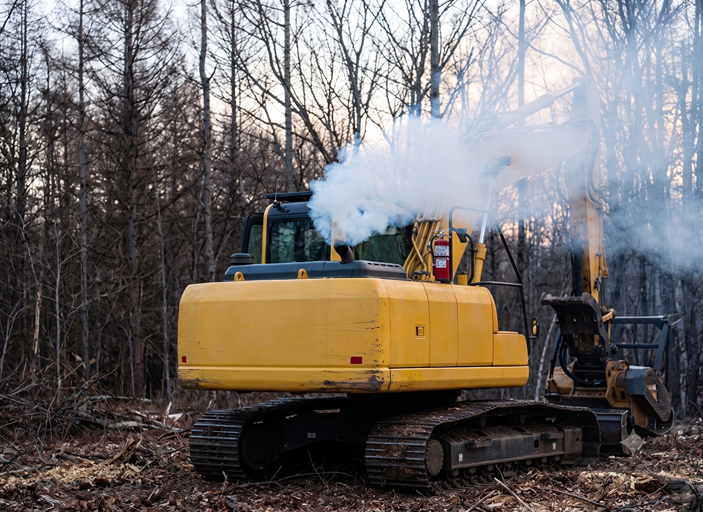
White smoke is the one owners search for most, and it’s the trickiest. White smoke can mean anything from “totally normal” to “shut it down right now,” and the clue is in when it shows up and whether it clears.
Cold-Start White Haze vs. Persistent White Smoke
A thin white vapor on a cold morning that burns off as the engine warms up is usually just condensation and a little unburned fuel. Nothing to worry about. Diesels do this in cold weather, and it’s easy to mistake for a real problem.
Thick, sweet-smelling white smoke that won’t quit is the one to worry about. That’s usually coolant getting into the cylinders through a blown head gasket or a cracked head, and it’s serious. If you’re topping off coolant and can’t find a puddle under the machine, it may be going out the stack instead. Persistent white smoke can also come from injection timing that’s off, bad injectors, or weak compression, so it’s worth a real diagnosis rather than a guess.
If the thick white smoke sticks around after warm-up—especially if you’re losing coolant—shut it down. Don’t run the machine hoping it clears. It won’t. Coolant in the wrong place causes catastrophic, expensive damage fast.
Gray Smoke
Gray usually means a fuel-and-oil mix, a failing turbo, or on modern machines an aftertreatment or regen event rather than an engine problem. If it shows up during or right after a regen cycle, that’s often normal. Constant gray is worth a look.
On Modern Equipment, Fault Codes Beat Smoke Color
“On later-model engines, almost everything is monitored and will have a fault code. That’s where you want to start.”
On any Tier 4 or newer machine, the fault code tells you more than the smoke color ever could. Almost every system is monitored, so when something fails, the engine usually throws a specific active code before you even notice smoke.
That’s why we start on newer equipment with a scan, not a guess at the stack. Pull the active codes first. They point you at the actual failing part, a turbo or a bad sensor, instead of a color that’s been filtered past the point of telling you anything.
When to Stop Running Your Machine (the Downtime Math)
Every operator asks us the same thing when the smoke shows up: “Can I finish the day, or do I have to shut it down?” We’ll give you the honest answer, and it’s usually the same one.
“Everybody should stop operating their equipment as soon as the issue appears, because even a few minutes of continued operation can be the difference between a minor repair and a major repair.”
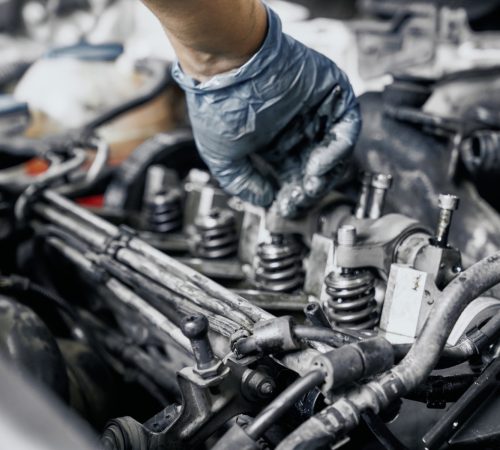
Do This the Moment You See Smoke
- Stop operating as soon as it’s safe. Don’t try to finish the job. The damage that matters happens fast.
- Check the active fault codes. On modern engines, that’s where the real answer is. Start there, not with the smoke.
- Don’t guess at the codes. If you can’t read them, call someone who can before you run the machine again.
- Get it inspected. Confirm the diagnosis and the fix before the machine goes back to work.
Here’s what “a few minutes” actually costs. An operator heard a light tick out of a Kubota V3800. He did the right thing at first — shut it down, checked his fluids, found everything normal. Then he fired it back up. Within minutes the tick got worse, the crankshaft snapped, and the engine jolted to a dead stop. The crank was beyond repair, the block needed extensive machining, and that one restart added more than 50% to the cost of the rebuild.
That job started with a noise instead of smoke, but the lesson is the same either way. The machine gave a warning, the warning got a second chance, and the second chance is what wrecked it.
We get it: downtime feels expensive. An idle crew and a rental machine add up fast. But pushing a smoking machine “just to finish the day” is exactly how a minor fix turns into a massive repair bill. The same lesson shows up in how long a well-maintained skid steer lasts: catch it early, and it stays cheap.
Where There’s Smoke, There’s a Fix: Let Us Take a Look
Whether it’s a skid steer or a full-size excavator, the color just points you in a direction. Getting the real diagnosis fast, before a small problem turns into a rebuild, is the part that saves you money.
Stop guessing at the stack. Contact Sur-Flow Hydraulics & Equipment Repair today. We’ll pull the codes, find the real cause, and give you a straight estimate with zero surprises. We handle everything from basic diagnostics to full diesel engine rebuilds, and we’re right here in Honey Brook, PA, serving contractors, fleets, and farms across Chester County.
Need it handled now? Request a free quote or call 484-901-6231. Don’t let a smoking diesel derail your timeline. Give us a call.
Diesel Smoke Color FAQs
1. What do the different colors of diesel smoke mean? Black smoke means the engine is burning too much fuel or not getting enough air. Blue smoke means it’s burning engine oil. White smoke means coolant, or unburned fuel on a cold start, is getting into the cylinders. Gray smoke usually points to a fuel/oil mix, a failing turbo, or an aftertreatment issue on newer machines.
2. Why is my diesel blowing white smoke? A thin white haze on a cold start that clears as the engine warms up is often normal. Thick or lasting white smoke usually means coolant is entering the cylinders, often a blown head gasket or cracked head, or that you have an injection or compression problem. If it doesn’t clear, stop running the engine and have it inspected.
3. Why do diesels blow black smoke on acceleration? Under hard acceleration, the engine demands a lot of fuel fast, and if it can’t get enough air to burn it all cleanly, the extra goes out as black smoke. On older engines, that often means a dirty air filter, injectors, or timing. On modern Tier 4 equipment, visible black smoke usually points to an EGR or turbo problem.
4. Is black smoke bad for a diesel, or can I keep running it? Visible smoke always means something is off, and on modern equipment it usually means a real fault. Running the machine anyway risks turning a small repair into a large one. The safest move is to stop, pull the fault codes, and get it checked before you keep working.
5. What color smoke means a blown head gasket? Thick white smoke that smells sweet and doesn’t clear after warm-up is the classic sign of a blown head gasket or cracked head letting coolant into the combustion chamber. It’s often paired with coolant loss and overheating, and it needs attention quickly.